

NTC & Temperature Sensor Q&A
Q:What isNTC thermistors?What types are there?
A:The property where resistance decreases as temperature rises is called negative temperature characteristics, and thermistors used to represent negative temperature characteristics are calledNTC thermistor (Negative Temperature Coefficient Thermal sensitivity resistor).
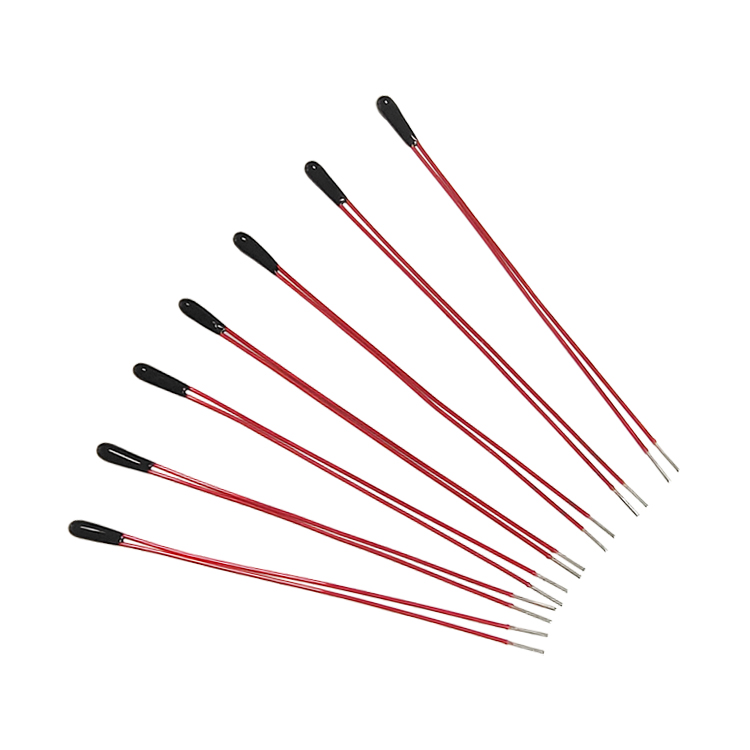
Common types include: single-ended glass sealed type, bead type with small black head, bead type with enameled wire, bead type with small leather wire, snap-fit small black head, insulated film type, diode,Power typeand chip resistors.
Q:What are the technical parameters of an NTC thermistor? Please provide examples.
A:The main technical parameters include: nominal resistance (5K/10K/50K/100K...), resistance tolerance (accuracy)(1%/3%/5%/10%), resistance temperature coefficient (B value) (3270/3380/3435/3470/3950/4000/4050/4500...), operating temperature range (℃) (-30℃-105℃/-30℃-125℃/-40℃-250℃...), material constant, time constant...
Q:What isWhat is the B value of an NTC thermistor?
A:The B value is the material constant (thermal index) of a temperature coefficient thermistor, with units of Kelvin temperature (K). After high-temperature sintering, the semiconductor ceramic undergoes a series of processing steps to form an NTC thermistor chip with a certain resistivity. Each formula and sintering temperature has only one B value. The B value of an NTC thermistor is positively correlated with the product's temperature coefficient of resistance, meaning that the larger the B value, the larger its temperature coefficient of resistance.
The B value formula for NTC thermistors is: B=T1T2Ln(RT1/RT2)/(T2-T1), where B: B value of the NTC thermistor, provided by the manufacturer; RT1, RT2: resistance values of the thermistor at temperatures T1 and T2 respectively; T1, T2: absolute temperature scale.
The B value of NTC thermistors generally ranges from 2000K to 6000K, and different B values can be selected based on different application ranges. Generally, for products used for temperature measurement, temperature compensation, and surge suppression, a larger B value can be chosen. This is because as the temperature changes, products with a larger B value have a greater change in resistance, meaning that the larger the B value of the NTC thermistor, the more sensitive it is during use, and the faster the response time.
Q:OrderWhat data is required when ordering an NTC thermistor?
A:If the resistance type is already determined, you need to provide the resistance value,B value, accuracy, and the required length of the resistor; if the type is uncertain, you need to provide the temperature, usage scenario, resistance value, B value, accuracy, and the required length of the resistor.
Q:How fast is the response time of an NTC thermistor?
A:Response time is defined as reachingthe time required for 62% or the new temperature, and it is a function of quality. The smaller the sensor, the faster the response. The response speed of discrete sensors is faster than that of the same sensor packaged in a metal shell. The typical response time of the MF52 series NTC thermistor sensors is <15 seconds.
Q:What type of temperature sensors does your company's temperature sensor belong to? What types are there?
A:Most of our company's temperature sensors areNTC type temperature sensors, depending on the usage scenario and structure, are available in straight tube type, threaded type, flange type, bullet type, epoxy resin encapsulated type, lock washer terminal type, ABS plastic shell type, and film type. In addition, our company also has PT100/PT1000 temperature sensors, DS18B20 temperature sensors, thermocouples, and infrared temperature sensors.
Q:Do you have your company's temperature sensors in stock? Do you support customization?
A:Temperature sensors are specific products, and customer needs vary. Stock products are mostly epoxy resin sealed types, with fewer other types.
Our products support customization. Thermistors that need to be used are available for selection. Other customizable parts include: length, size, and shape of metal parts, model, specification, and length of wires, and selection of different types of connectors.
Q:If the type of temperature sensor to be used is unclear, can you recommend one?
A:Certainly. Because we deal with many types, when customers are unclear, we will recommend products based on their usage scenarios and specific needs, so that customers can get satisfactory products. Additionally, we can also cooperate with customers to adjust product designs in a timely manner according to their requirements to customize the satisfactory products they need.
Q:Does it involve new energy products?
A:New energy has been a hot topic in recent years, and it must be included in our products. Not only new energy,We are also involved in products used in 3D printing and other fields, and our scope is quite broad.
-.-.-.-.-.-.-.-.-.-.-.-.-.-.-.-.-.-.-.-.-.-.-.-.-.-.-.-.-.-.-.-.-.-.-.-.-.-.-.-.-.-.-.-.-.-.-.-.-.-.-.-.-.-.-.
Q: How can I obtain the R-T table for NTC thermistors and temperature sensors?
A: Yes, products will have corresponding R-T tables, and data from different manufacturers inherently have differences. If you need an R-T table for a specific product, please contact our staff for consultation.
Q: Can your company help design products and draw diagrams?
A: Yes, it is possible. Product drawings require data for each component of the product, including material, dimensions, and other special requirements, and also require special authorization.


